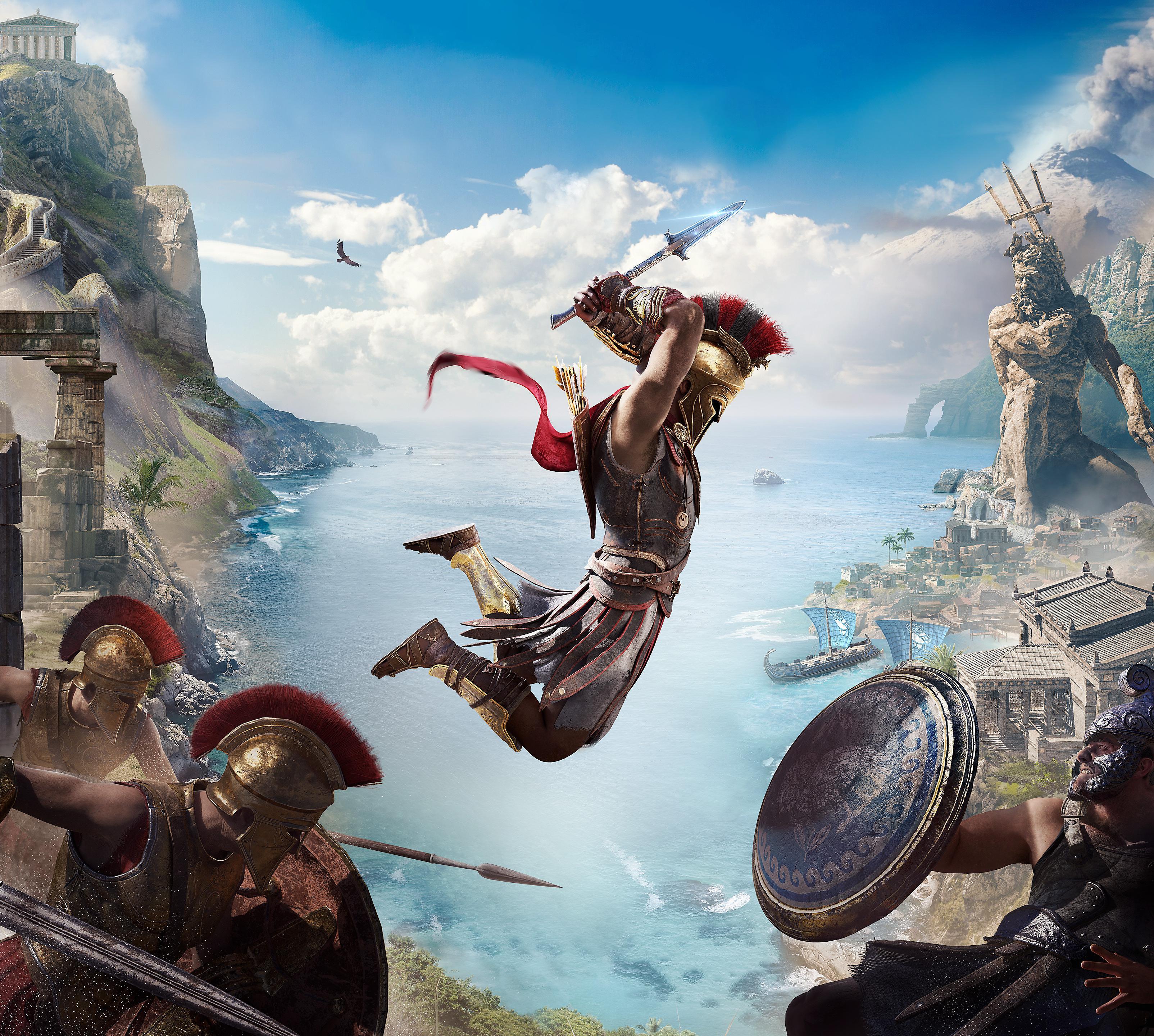
About this scenario
What matters for Assassin's Creed Odyssey
Assassin's Creed Odyssey is an open-world action RPG set across ancient Greece, where you play as a mercenary navigating war, mythology, and political intrigue. The game spans a massive map dotted with cities, islands, forts, and naval combat zones, all running on Ubisoft's AnvilNext engine. It is a single-player experience built for long exploration sessions, so stable performance directly shapes how immersive the world feels.
At 1440p, the game's hardware demands shift meaningfully compared to 1080p. A higher-resolution output makes GPU load more pronounced — volumetric clouds, shadow cascades, environment detail, and high-resolution textures all demand more graphics headroom. A capable GPU with sufficient VRAM becomes essential for keeping visual settings high without compromising smoothness during fast traversal and combat.
But here is where many PC builders get tripped up: Odyssey is famously CPU-sensitive in busy areas. Cities like Athens and large battle zones push the game's NPC crowd simulation and world-streaming systems hard, creating bottlenecks that no GPU upgrade alone can fix. Even at 1440p, a strong multi-core CPU is necessary to maintain consistent frame pacing. The game's DX11 heritage also means that driver overhead can become a factor under heavy simulation workloads.
If you are searching for the best 1440p PC build for Assassin's Creed Odyssey, keep in mind that system requirements alone do not tell the full story. Lean too far toward an expensive GPU with weak CPU support and you may still see stuttering in the places where you spend the most time.
Performance priority
Sharp visuals with stable frame pacing across towns and open terrain
Component focus
At 1440p, the GPU does more work rendering Odyssey's volumetric skies, distant terrain, and high-resolution textures — but the CPU still matters just as much in NPC-dense areas where the engine's simulation logic strains even strong processors. You need both sides covered.