About this scenario
What matters for DOOM Eternal
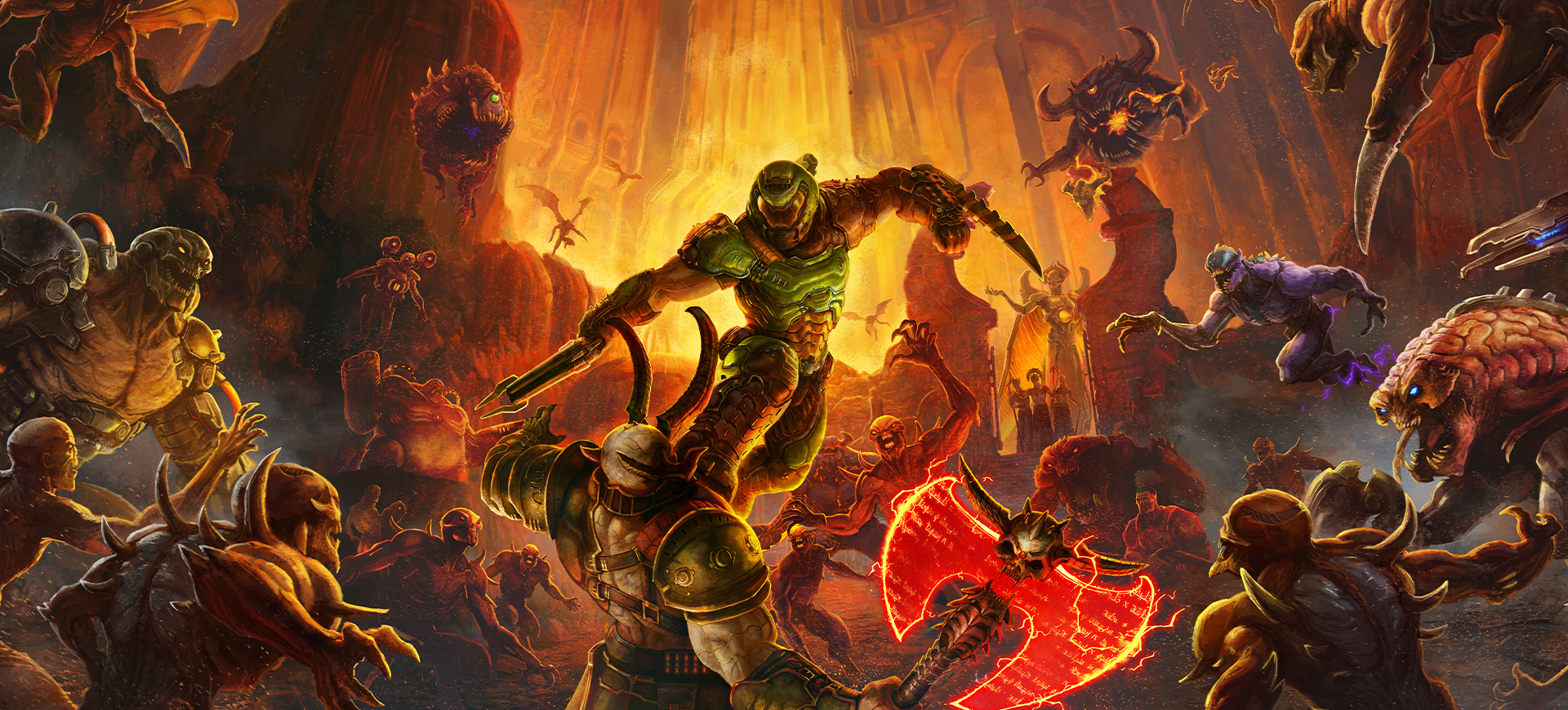
DOOM Eternal is a fast-paced first-person shooter from id Software that trades methodical cover-based gameplay for aggressive, always-moving demon combat. Players chain dashes, double jumps, and glory kills across sprawling arena levels, swapping weapons constantly to exploit enemy weak points. The campaign spans dozens of hours across multiple difficulty settings, and recent official mod support has added a new layer of variety for PC players. Performance directly shapes the experience here because the game's rhythm depends on smoothness. A dropped frame during a mid-air weapon swap or a stutter right before a glory kill breaks the flow that makes combat feel satisfying. Under the hood, DOOM Eternal uses the id Tech 7 engine with a Vulkan renderer that hands most of the heavy lifting to the GPU, keeping CPU requirements modest. That means the game scales well on older or mid-range processors, but the graphics card still determines how high you can push settings and how stable the experience remains during particle-heavy fights with multiple demons. Explosions, dynamic lighting, and high-detail textures are the biggest performance sinks. First-time builders often underestimate the GPU's importance or worry whether their current system meets the system requirements at all. In practice, DOOM Eternal is well-optimized and runs on a wide range of hardware—the real question is how much visual quality and smoothness you want from your PC build.
Performance priority
Consistent, stutter-free action at high visual settings across varied hardware demands
Component focus
The graphics card carries the heaviest load in DOOM Eternal thanks to its Vulkan-based rendering pipeline, so a 16GB GPU like the RX 9060 XT is the centerpiece of this build. A six-core Zen 4 processor handles game logic and background tasks fluidly, and a fast NVMe SSD keeps the constant texture streaming from becoming a bottleneck.